The Queen of Spices’ Past: From Royal Drinks of Ancient Civilisations to the World’s Finest Desserts
Known as the “Queen of Spices”, the vanilla orchid (Vanilla, commonly just called vanilla) is the only member of the vast orchid family whose fruit (the vanilla pod) is edible. It is native to tropical rainforests, where it climbs upwards, its aerial roots winding around supports, and the fragrance it develops has become the soul of desserts and ice creams around the world.
Vanilla has a long history and was added to the drinks of the elite very early on. Traces of vanillin have been found in pottery jars in an ancient Israeli tomb dating from around 2000 BC, and in wine jars belonging to Judahite nobles in Jerusalem dating from 586 BC. By the 16th century, the ancient Maya and Aztec civilisations of Central America were making vanilla into drinks, and by the 18th century it had become a dessert of the European aristocracy. Today, vanilla from the world’s main producing regions, Madagascar, Réunion and the tropical areas along the Indian Ocean coast, accounts for about two-thirds of global supply. It comes mainly from the tropical regions of Madagascar, Réunion and the Indian Ocean coast.
The main vanilla varieties on the market today are Madagascar’s “Bourbon vanilla (Vanilla planifolia)” and “Tahitian vanilla (Vanilla tahitensis)”.
- Tahitian vanilla: large, plump pods with a floral, stone-fruit aroma that releases its fragrance without high heat; it also costs twice as much.
- Madagascar’s “Bourbon vanilla”: supple, with high moisture content, very ripe and dark in colour, with a creamy aroma that comes out at high temperatures, making it well suited to baking. It is more affordably priced, at around NT$110 per pod. The variety introduced to and grown in Taiwan in 2007 is Bourbon vanilla.
The Only Edible Fruit in the Orchid Family, and the Precious “Golden 5 Hours” of Hand Pollination
The vanilla orchid’s flowering period is extremely short. It blooms only once a year, and growers must complete hand pollination within a golden window of just 5 to 6 hours. Not only is time tight, but of the more than one thousand flowers blooming in a field, only 40 to 50 are chosen for pollination. The selected flowers can then absorb more nutrients and grow high-quality vanilla pods, which is what gives vanilla its fine fragrance and high price.
The vanilla orchid does not need any special pesticide spraying while it grows, because overuse of chemical fertilisers and pesticides can damage both the fragrance and the health of the plant. Consumers who want to be sure the vanilla pods they buy are pesticide-free can ask the shop whether it can provide an SGS test report showing no residues of a range of pesticides.
After a 3–4 month growing period, the ripe pods are picked and must go through processing steps of “killing, fermenting and ageing (curing)”, which turn the glucovanillin in them into vanillin, the source of the aroma. Only then do they become the precious, high-grade spice found on the market.
Vanilla’s Modern Miracle in Taiwan: High-Tech Greenhouses Growing Internationally Three-Star, Grade A Vanilla Pods
After many years of hard work growing vanilla in Taiwan, the results now shine like the glossy black seeds of the vanilla pod itself. In April 2024, the Taoyuan District Agricultural Research and Extension Station (桃園區農業改良場) and the vanilla farm it advises once again won a three-star taste award from the International Taste Institute (iTQi) in Belgium, an honour they have received in consecutive years.
This vanilla farm in Xinwu (新屋) is an environmentally controlled greenhouse built on a steel frame. Its roof is covered with solar panels, combining farming and power generation (agrivoltaics, 農電共生), and inside the greenhouse automatic sensors trigger sprinklers to cool it down, so that almost one person alone can run it. One third of the high-quality vanilla pods it produces are 18 cm or longer and meet Grade A standards.
Pingtung (屏東) also has a large Taiwanese-Japanese joint greenhouse farm that uses technology-driven cultivation to grow and extract vanilla and markets it overseas. In addition, Taiwan has several other vanilla farms, in Hsinchu (新竹), Taoyuan, Nantou (南投) and Hualien (花蓮). A number of them have developed their own brands selling vanilla powder, vanilla extract and vanilla pods, and offer guided tours and DIY baking experiences. Anyone interested can book by phone or online and plan a day trip to one nearby.
Can Vanillin Help Prevent Parkinson’s Disease? Experts on Its Neuroprotective Potential and Everyday Diet Advice
The classic scent of vanilla has never gone out of style. Centuries ago it was cherished by the aristocracy, and today it is part of everyday desserts and food for ordinary people. Looking ahead, vanillin, which is believed to have therapeutic and health benefits, looks set to join the world of medicine and health care.
Research reports indicate that vanillin (Vanillin, Van), like curcumin, can protect neurons (dopaminergic neurons) from damage, and medical institutions are now actively studying its potential use for Parkinson’s disease.
Parkinson’s disease (PD) is a neurodegenerative disease whose pathology is linked to oxidative stress and damage to mitochondria.
In experiments on mice, researchers found that vanillin (Vanillin, Van) reduced neurobehavioural disorders and oxidative stress in the mice, and prevented abnormal protein expression in the substantia nigra pars compacta (SNpc) of the brain, the loss of endogenous dopaminergic neurons, and damage to the nerve fibres projecting to the striatum.
They therefore concluded that vanillin (Vanillin, Van) has antioxidant, anti-inflammatory and neuroprotective properties. Like curcumin, it can protect dopaminergic neurons and improve movement disorders (dyskinesia).
But can eating more vanilla or turmeric in our daily diet help prevent Parkinson’s disease? The answer is no: the amount of vanilla or turmeric we take in through everyday food is not enough to have a preventive effect. If, in future, more clinical trials confirm that vanilla can prevent Parkinson’s disease, it may be developed into medicines or health supplements, as turmeric has been, and that would greatly ease people’s fear of Parkinson’s disease.
Until then, the safest and most effective antioxidant approach to preventing neurodegeneration is still regular aerobic exercise and eating plenty of fruit and vegetables rich in flavonoids and foods rich in Omega-3 fatty acids.
- Fruit and vegetables rich in flavonoids: blueberries, strawberries, oranges, onions, broccoli, spinach.
- Omega-3 fatty acids: mackerel, Pacific saury, salmon; vegetarians can eat flaxseed, chia seeds, nori and kelp.
New Breakthroughs in Sustainable Vanilla: Natural Vanillin from Papermaking Wastewater and Rice Bran
In recent years, abnormal weather causing droughts and hurricanes, together with growing awareness of exploitation in developing countries, has made vanilla pod supply, demand and prices volatile. Farmers in Sambava, a vanilla-growing area of Madagascar, have chosen to stop growing vanilla, making the vanilla market increasingly fragile and prompting scientists to speed up research into “artificial vanilla”.
To develop an artificial flavouring, you first need to understand how vanilla gives off its alluring aroma. In recent years, an aroma analysis method called “non-targeted flavouromics” has become popular. It is used to identify which chemical substances are mainly responsible for a scent and how they interact with one another, so that people can associate a particular flavour with something just by tasting or smelling it.
Natural aromas contain large numbers of volatile aromatic compounds that give them their fragrance; on average, a single flavour needs a combination of at least three volatile compounds. Vanilla’s main aromatic compound, vanillin, gives off sweet, creamy and floral notes. Combined with two other compounds, eugenol and methyl cinnamate (both of which are also key components of spices such as cinnamon, basil and bay leaves), it gives vanilla a rounded, richly layered aroma.
With current technology, 85% of vanillin is artificial (also called “organic aldehyde”). It is mainly made from benzene derived from petroleum, or extracted from lignin, a by-product of industrial pulp waste liquor. Nearly 700 billion litres of papermaking wastewater are produced worldwide each year, and every litre contains 600–1,000 mg of lignin that pollutes the environment. As industrial mass production creates waste-disposal problems, how to reduce and treat industrial and agricultural waste has become a prominent field of study at universities around the world. The following research results have already been achieved:
In January 2023, an experiment at Johannes Gutenberg University Mainz (Johannes Gutenberg-Universität Mainz) in Germany electrolysed lignin from wood, using a carbonate solution (a solution originally used to improve the colour, strength or water resistance of paper) instead of copper as the catalyst, and extracted vanillin. Producing vanillin in this way from lignin, a by-product of papermaking wastewater, is not only cheap and makes use of waste, but is also more environmentally friendly and sustainable.
Soon after, in June 2024, Tokyo University of Science in Japan also succeeded in producing natural vanillin using a bioengineered enzyme. They first obtained the compound ferulic acid from agricultural waste such as rice bran and wheat bran, then mixed the ferulic acid with the enzyme they had developed at room temperature to produce vanillin. This is another cheap, sustainable and simpler way of obtaining vanillin.
The vanillin extracted by these two universities with their breakthrough technologies is promoted as low-cost and as a green, circular way of handling waste that is also environmentally sustainable. Both have become a focus of attention for sustainable industrial development worldwide, though how well consumers will accept vanillin synthesised from industrial and agricultural waste has yet to be tested on the commercial market.
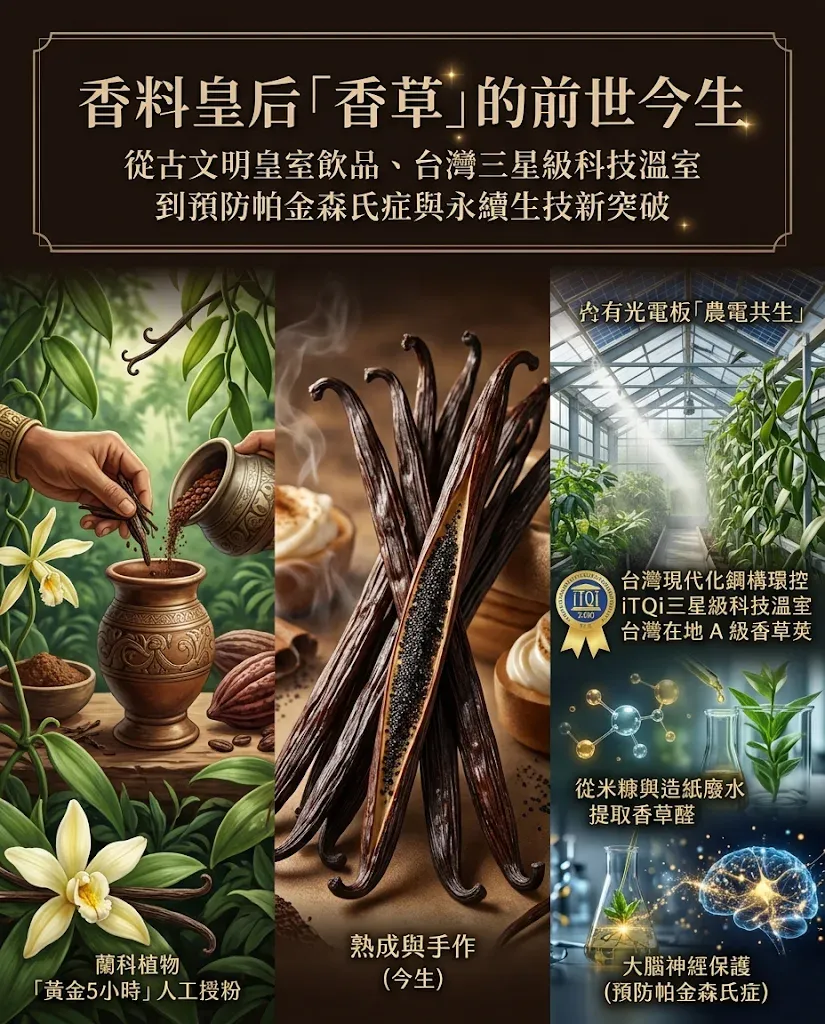
English text of this image
The past and present of vanilla, “queen of spices”: from royal drinks of ancient civilisations and Taiwan’s three-star high-tech greenhouses to preventing Parkinson’s disease and new breakthroughs in sustainable biotech.
- An orchid’s “golden five hours” for hand pollination
- Curing and handwork (the present)
- Solar panels: farming and solar power together
- Taiwan’s modern steel-frame, climate-controlled greenhouses; iTQi three-star award; Grade A vanilla pods grown in Taiwan
- Vanillin extracted from rice bran and paper-mill waste water
- Protecting the brain’s nerves (preventing Parkinson’s disease)
References:
https://www.eurekalert.org/news-releases/1044725 “Bioengineered enzyme creates natural vanillin from plants in one step”
https://www.europeanscientist.com/en/agriculture/green-way-to-produce-vanillin-from-lignin/ “Green way to produce vanillin from lignin”
Enjoyed this article? Get the newsletter
Our newsletter is written in Chinese for now: new articles and series, with an editor’s note. No spam, and you can unsubscribe at any time.