In the two decades after the Second World War (the 1940s to 1960s), farmland was over-sprayed with pesticides, polluting groundwater and soil and even making pests and diseases resistant to the chemicals, so that problems became thornier and harder to control.
When growing scallions, farmers have to fight different pests and diseases in different seasons:
All year round: the beet armyworm
From winter to the following spring: black rot, downy mildew and rust
From summer to autumn: anthracnose, soft rot, thrips, mites and other pests and diseases.
Scallion Prices Soar in Abnormal Weather, and Fake-Origin Scandals Follow
In an age when planting plans cannot keep up with a changing climate, every farmer faces the same challenge: how to avoid crop losses and make crops more resistant to weather and disease, while using fewer pesticides.
In recent years, scallion fields in several northern coastal provinces of mainland China have expanded, with bumper harvests. Scallion farming in Taiwan, Japan and South Korea, however, has followed the wider trend: all three face an ageing farming workforce and a lack of successors. Add to this the gradual shrinking of farmland and the effects of extreme heat and torrential rain, and crops often fail.
Scallions dislike both rain and heat, and typhoons repeatedly cut the harvest. Taiwanese scallions, which normally retail at NT$50–120 per jin (斤, 600 g), shot up to more than NT$300 per jin in November 2024 and August 2025. Price differences several times over tempted traders to take risks for big profits, leading to scandals in which “imported Chinese scallions were passed off as local ones”:
- June 2026, Japanese Kujo scallions: extreme heat caused a shortage of leaf scallions in Japan. To meet market demand, local Japanese traders imported scallions from mainland China and passed them off as “Kujo scallions produced in Kyoto Prefecture”, hoping to cash in on both the deception and the opportunity. Once exposed, they were investigated for violating the Unfair Competition Prevention Act (《不正競爭防止法》).
- April 2024, frozen scallions in Taiwan: a Taiwanese food company imported 1,900 cases of frozen scallions from mainland China and sold them as Taiwanese scallions. It was convicted of “making false entries in business documents” (行使業務登載不實文書罪), sentenced to six months in prison and fined NT$200,000.
- September 2025, scallions imported from Japan: Taiwan also imports scallions from Japan; one consignment was stopped at the border and returned because its pesticide residues exceeded the limits (failed inspection).
When bad weather ruins the crop and their income falls, Taiwanese scallion farmers can only watch as importers profit from the opportunity. When scallion prices are good and farmers all rush to plant scallions to catch the price wave, too many scallions flood the market at once and prices fall instead. Between failed harvests and bumper ones, farmers work hard for little reward.
Caught in this dilemma, scallion farmers need government agencies to gather reliable market information so they can predict how much scallion and onion seed to sow, or whether to switch to other crops, to meet market demand and secure a stable income.
They also need to make scallions hardier and reduce pesticide use, so that their produce is not pulled from shelves and destroyed after going on sale because of excessive pesticide residues. On this point, let us first look at why scallions carry such high pesticide residues.
Why Are Pesticide Residues on Scallions So Persistently High? Three Built-In and Growing Problems
Scallions regularly appear on the “list of pesticide residues in fruit and vegetables” published each year by the Council of Agriculture (COA, 農委會). Scallion farmers spray too much pesticide because scallions are naturally prone to pests and disease, because their shape makes it hard for pesticides to stick, and because they are farmed intensively:
Prone to disease: scallions can be grown in every season, but their fatal weakness is low resistance to pests and diseases. In summer and autumn especially, rain and poor drainage turn the fields into breeding grounds for pests and disease. Farmers therefore have to spray pesticides to stop the scallions withering or rotting black and losing their market value.
The shape of the scallion: each stalk grows straight upwards, and the waxy surface of the leaves repels water much like a lotus leaf. Together, these make pesticides slide off rather than stick.
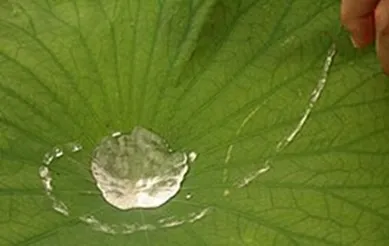
Image source: Wikipedia / Lotus effect
Intensive farming: the fields are planted densely, and scallions of different ages, some still growing and some ready to harvest, are planted very close together. When pesticides are sprayed, some inevitably drift onto patches that do not yet need them, so some scallions absorb too much.
So when the weather forecast warns farmers to prepare for strong winds and torrential rain, they hurry into the fields to harvest early, so that their hard work is not washed away.
Some of these early-harvested scallions may be picked before the pesticides have fully broken down and, without being sampled and tested by residue experts, are sent to wholesalers or even put on sale, so pesticide residues can occur.
Unless scallions are organically grown, pesticide residues are a problem whether you buy Taiwanese, mainland Chinese or Japanese scallions. Even when the market is short of scallions, imports with excessive pesticide residues are still stopped at the border.
To make progress on protecting consumers’ food safety, securing farmers’ harvests and reducing pesticide use, scallion fields currently take three approaches: “smart disaster-prevention protected agriculture”, Traceable Agricultural Products (TAP, 產銷履歷) certification, and integrated pest management (IPM).
Scallion growing is easily affected by the seasons: drought during the growing period or rain at harvest time can do serious damage. To overcome bad weather and secure scallion yields, since 2017 the Agriculture and Food Agency (農糧署) has promoted “smart disaster-prevention protected agriculture” (智能防災設施農業), that is, greenhouse growing combined with smart environmental monitoring equipment, subsidising farmers to build greenhouses. Compared with growing in the open, greenhouse growing is estimated to cut typhoon and wind losses by 40–60%. The smart greenhouses already built privately are specified as follows:
Smart Disaster-Prevention Protected Agriculture (Greenhouse Growing)
- Insect netting: netting with a 2 mm x 2 mm mesh can withstand winds of force 11, the strength of a mild typhoon. (On the #Beaufort scale, winds of “force 10 and above” blow over potted plants, snap branches and utility poles, make outdoor activities dangerous and make it impossible to walk while holding an umbrella, like the winds when Typhoon Bavi struck in July 2026.) This gives an idea of how much wind the netting can withstand.
- Frame structure: the most common choice is galvanised steel pipe framing with pressing strips, with the internal frame joined and reinforced; with automatic opening and closing, it shields the crop even better.
- Smart monitoring equipment: smart environmental monitoring lets farmers keep track in real time of the temperature and humidity inside the greenhouse and how the crop is growing.
The experience of Sanxing scallion (三星蔥) growers in Yilan: they use structural windbreak netting (growers report that it blocks up to 70% of the wind) with H-beam steel, all steel and parts are stainless, and the bases are treated against rust. Smart greenhouse equipment is usually combined with toxin-free farming or organic growing.
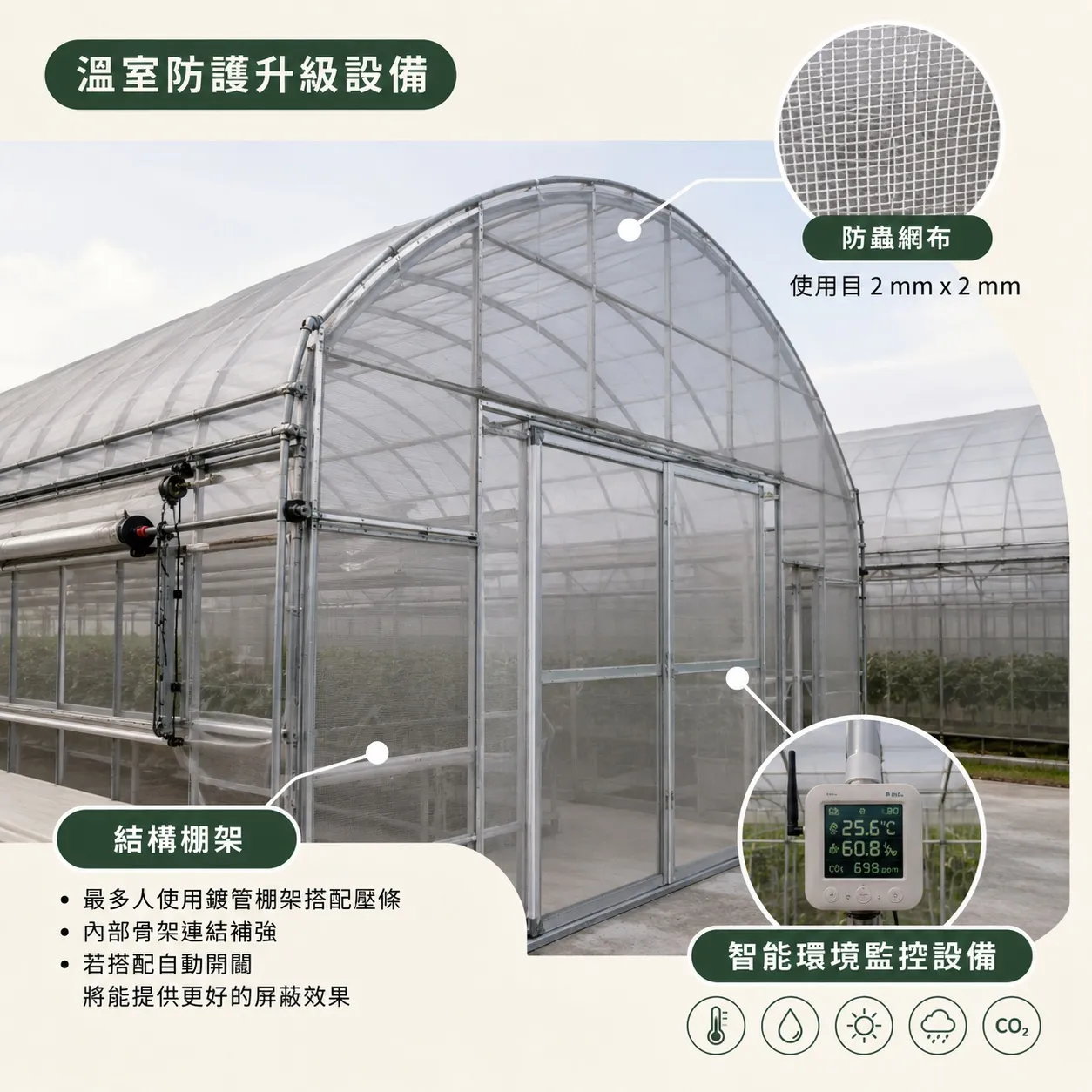
English text of this image
Greenhouse protection upgrades
- Insect netting: 2 mm × 2 mm mesh.
- Frame structure: most growers use galvanised-pipe frames with clamping strips; reinforce the joints of the inner frame; adding automatic opening and closing gives better screening.
- Smart environmental monitoring: temperature, humidity, light, rain and CO₂.
The Price Premium of Toxin-Free Farming
Besides promoting “smart disaster-prevention protected agriculture” to create a suitable environment for crops, the Agriculture and Food Agency also promotes the Traceable Agricultural Products certification system. If a problem arises, it can be traced back to its source and dealt with promptly, stopping an outbreak from spreading.
For both scallions and onions, field drainage is very important, because heavy moisture easily becomes a breeding ground for pests and disease that damage and riddle the leaves. Most farmers therefore still rely on insecticides and herbicides.
What Makes Toxin-Free Farming Different
In 2010, farmers grew onions using “toxin-free farming” (無毒農業) methods, without herbicides, fungicides or chemical fertilisers, and slightly adapted their growing methods for scallions as a crop:
- High beds and wide rows: beds are raised to help drainage and rows are spaced further apart for ventilation, reducing pest and disease problems caused by built-up humidity.
- Black soybeans instead of chemical fertiliser: onions are not forced along with constant fertilising. From sowing seedlings in October to harvesting the following April, the harvest comes about a month later than with conventional farming.
- No insecticides or herbicides: thanks to the luoshan wind (落山風), which drives insects away, there is no need for pest control.
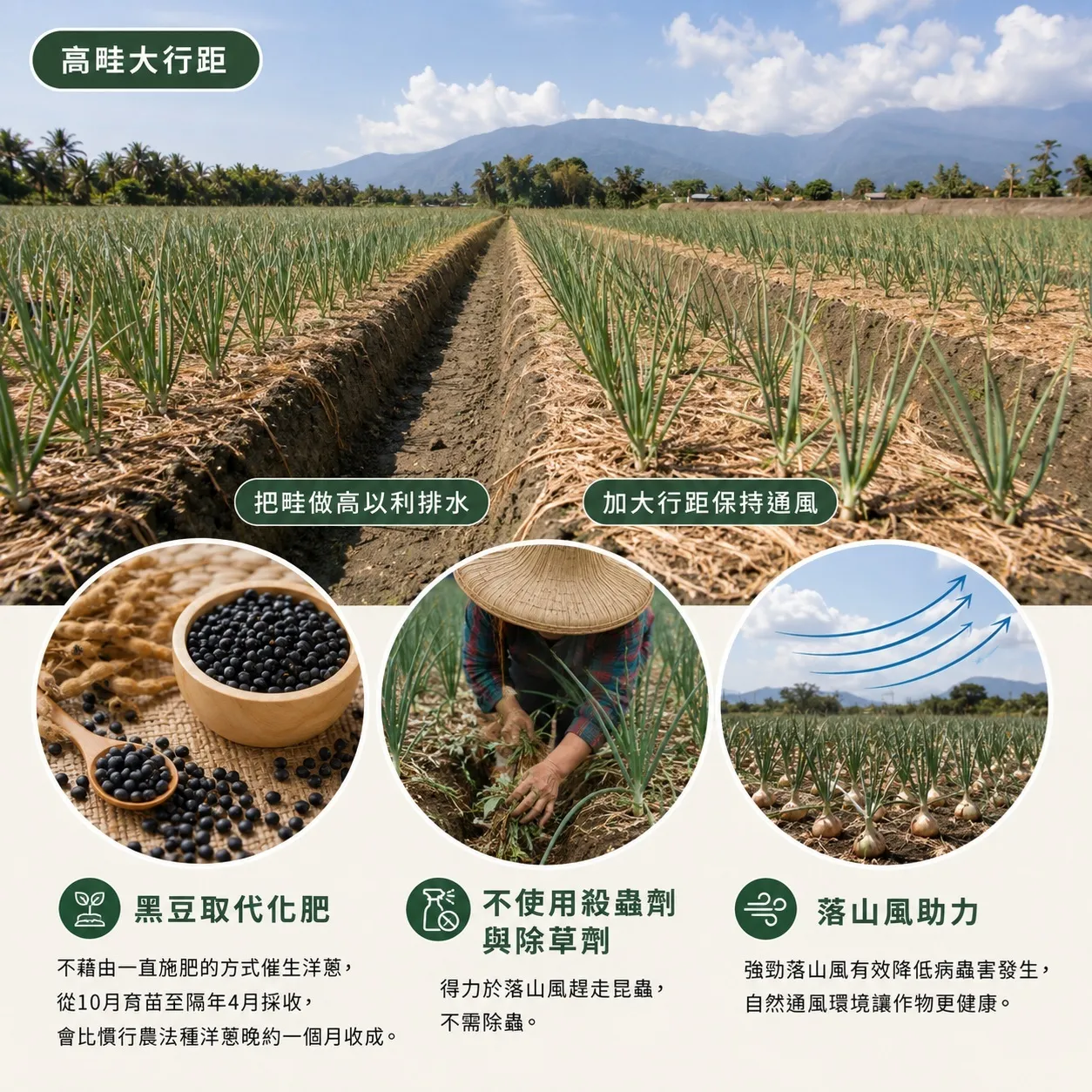
English text of this image
- Raised beds, wide rows: raise the beds for drainage; widen the rows for airflow.
- Black soybeans instead of chemical fertiliser: onions are not forced along with constant fertilising; sown in October and harvested the following April, they come in about a month later than conventionally grown onions.
- No insecticides or herbicides: the luoshan wind drives insects away, so there is no need to spray.
- Help from the luoshan wind: the strong wind cuts pests and disease, and natural ventilation keeps the crop healthier.
A Smaller Harvest, but Bigger Returns
The onions are smaller and the yield is lower, but they are juicy, with a layered pungency and heavy bulbs.
Although the yield cannot match onions grown conventionally, the retail price is up to three times higher! Five years on, more farmers had joined in, and a toxin-free farming cluster formed naturally.
Traceable Agricultural Products (TGAP): Managing from the Source
Growers in the Traceable Agricultural Products scheme must follow the rules and keep detailed records of the source of seedlings, soil management, irrigation water testing, pesticide and fertiliser rules, pest and disease control and records, harvest grading and cold storage equipment, and more.
Using the barcode on the product, consumers can find out the farmer and place of production, the production process and the verification items, including water source, soil, tests for eight heavy metals, product pesticide residue tests, on-site inspections and other related information. Buying farm produce whose source can be traced protects food safety.
The Difference Between “Toxin-Free Farming” and “Organic Farming”
“Organic farming” means growing without genetically modified seeds, pesticides, chemical fertilisers, plant growth regulators and so on.
- Controlling pests, diseases and weeds: driving away pests with natural enemies and microorganisms, bagging fruit and vegetables, setting up sticky traps and insect-trapping lights, and so on.
- Crop rotation to maintain soil fertility: land must lie fallow for 3 years before each planting.
- Natural fertilisers: animal and plant residues and the droppings of poultry or waterfowl are used as fertiliser to nourish the fields.
Organic certification bodies: the Agriculture and Food Agency authorises five certification bodies, the MOA Natural Ecology Foundation (國際美育自然生態基金會), the Tse-Xin Organic Agriculture Foundation (慈心有機農業發展基金會), the Formosa Organic Agriculture Development Association (台灣寶島有機農業發展協會), the Taiwan Organic Production Association (台灣省有機農業生產協會) and the Chinese Organic Agriculture Association (中華有機農業協會), each of which has designed its own certification mark.
“Toxin-free farming” builds on “organic farming”: it likewise uses no sprayed pesticides or chemical fertilisers during growing.
Farm produce that passes toxin-free testing is awarded a toxin-free farming certification mark by the county government. Through the production record, consumers can find out where the product was grown, the farmer’s details, the soil and irrigation water source, and the dates and results of agricultural tests, so they can buy with confidence.
- So organic farming and toxin-free farming use almost identical growing methods; they differ only in which body issues the certification and in the details. This makes them very easy to confuse and to fake, and consumers need to check for themselves to avoid buying falsely labelled products.
Victims of Their Own Fame: Fake Origins and Scallion Thefts
- 2007, Sanxing scallions, Yilan County: many scallions of uneven quality were on the market, calling themselves “Yilan Sanxing scallions”. Sanxing scallion is the name of a place of origin, and scallions not grown in Sanxing, Yilan, may not falsely claim the name to confuse buyers and push up prices. Farmers in Sanxing Township passed group traceability certification to protect the reputation of Sanxing scallions.
- 2019, Erlun leeks (二崙大蔥), Yunlin County: the leeks and shallots (分蔥, red shallots) grown in Erlun Township also gained traceability certification. But the good prices caught the eye of thieves who knew their value, and in September 2025 a helpless farmer in his eighties had no choice but to guard his fields overnight with his son, and even sold to buyers early to avoid being robbed again.
Shift work is no longer just the custom of service industries, public utilities, medicine and manufacturing. Sharp-eyed thieves have spotted the value of scallions and steal them under cover of darkness, so helpless scallion farmers have started taking turns keeping watch at night to avoid losses.
IPM: Integrated Pest Management of Crops
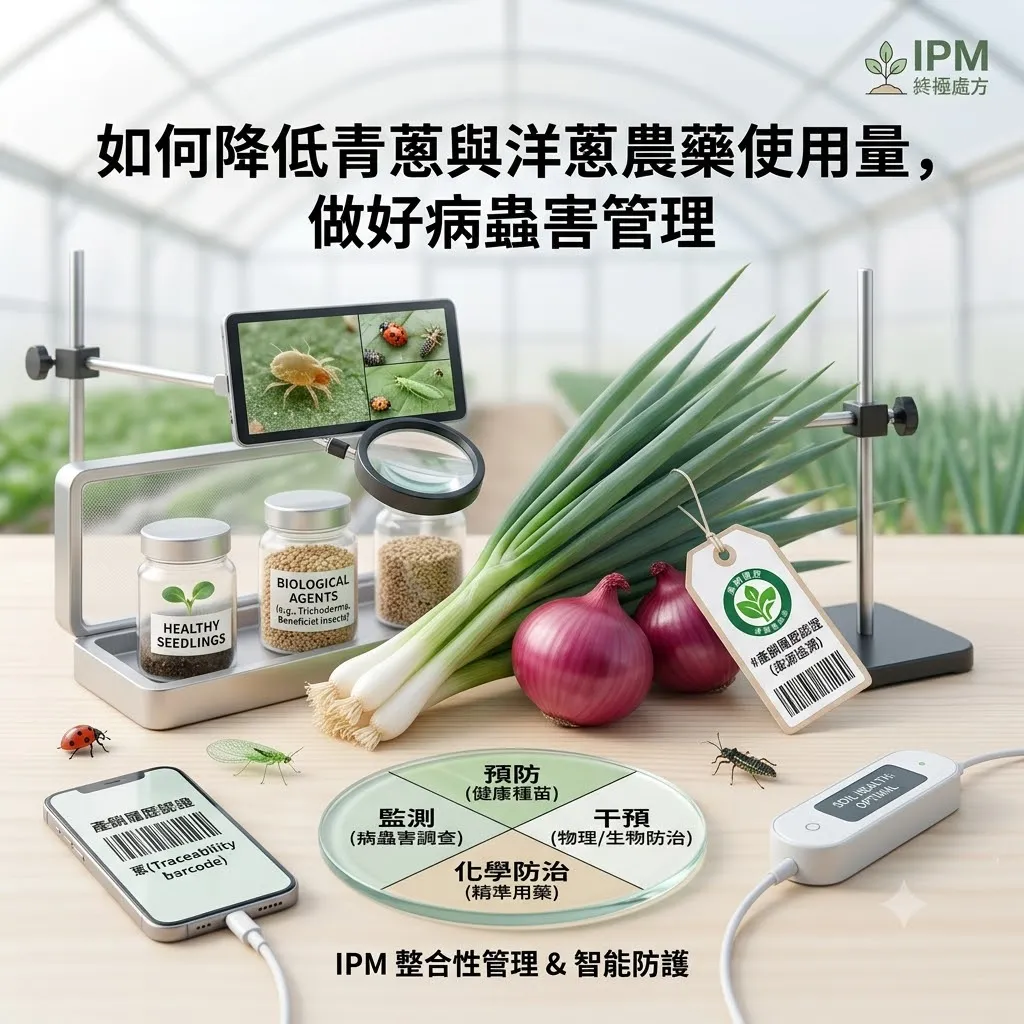
In recent years, the government has begun promoting “integrated pest management of crops (Integrated Pest Management, IPM)” (作物病蟲害整合性管理) as a solution for controlling pests and diseases.
Through “prevention”, “monitoring and assessment” and “intervention”, it sets a reasonable tolerable level of crop loss, the economic threshold (Economic Threshold, ET), and finds the best way to control pests and diseases while using fewer pesticides.
- Healthy seedlings: planting the right crop in the right place, steam-sterilising the soil, assessing the type, timing and amount of fertiliser, and pre-treating seedlings with diatomaceous earth and microorganisms so that crops grow strong and healthy.
- Biological control: experimenting on local pest populations to understand pests, diseases and soil characteristics in different areas, so that precise treatment prescriptions can be given.
- Physical control: controlling pests and diseases without chemicals, including isolation netting, fruit bagging, sex-pheromone traps and insect lights, and subsidies for plant-protection materials.
- Chemical control: adjusting the types of pesticide used sensibly according to monitoring, and releasing suitable numbers of predatory insects as natural enemies. Excessive fertilising and spraying are discouraged to limit damage to the environment and avoid pest resistance. If produce on the market is found to exceed pesticide residue limits, it is pulled from shelves and destroyed, so farmers must use pesticides with care.
- Plant doctor training: technical guidance from the Hualien District Agricultural Research and Extension Station (花蓮區農業改良場), field coaching, seminars, and training plant doctors to serve farmers.
Results of IPM trials: in Yilan, chemical pesticide use was cut by 10–90%, reducing the impact on the environment and ecosystems. Economically, pest and disease control costs fell by more than 20% and overall yields rose by 10–25%, bringing farmers higher income and profits.
IPM is built on ecology and environmental sustainability while seeking the greatest economic benefit. IPM was first introduced in Sanxing, Yilan in 2014, and according to official data the trial went well at the time. But judging by how scallions have stayed on Taiwan’s Dirty Dozen list over the past decade, it still needs to be adopted more widely.
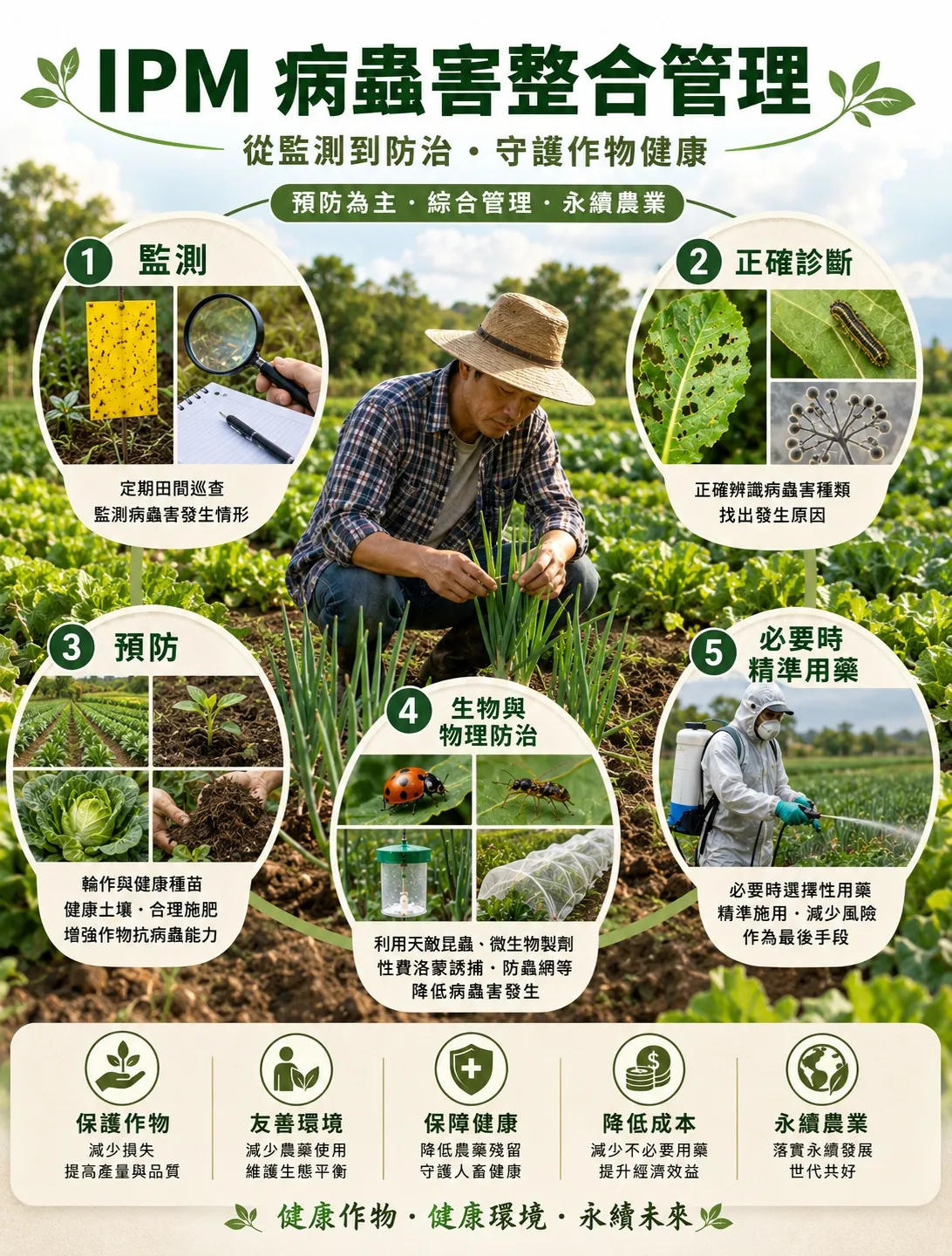
English text of this image
IPM: integrated pest management. From monitoring to control, protecting crop health. Prevention first, combined management, sustainable farming.
- 1. Monitoring: regular field checks to track pests and disease.
- 2. Correct diagnosis: identify the pest or disease correctly and find the cause.
- 3. Prevention: crop rotation and healthy seedlings, healthy soil and sensible fertilising, to build the crop’s resistance.
- 4. Biological and physical control: natural-enemy insects, microbial products, sex-pheromone traps and insect netting, to reduce outbreaks.
- 5. Precise spraying only when needed: selective, precisely applied pesticides to reduce risk, as a last resort.
Benefits: protects crops (less loss, better yield and quality) · kind to the environment (fewer pesticides, ecological balance) · protects health (lower residues, for people and animals) · lowers costs (no unnecessary spraying) · sustainable farming (for generations to come). Footer: healthy crops, a healthy environment, a sustainable future.
Overall Comparison
Among the growing methods, IPM seeks the greatest economic benefit while reducing the use and cost of pesticides and fertilisers and being kind to the environment. It scores highest overall of all the farming methods, but unfortunately it is not widely adopted. Crops grown with “toxin-free farming” use no pesticides or chemical fertilisers at any stage, drive away pests and diseases by natural means, have their water tested regularly and come with production records, safeguarding consumers’ food safety; it is the method used by the most farmers. Whichever method scallion farmers choose, they still have to overcome the wider environment to supply the scallions and onions the market needs. Combining them with the hardware of “smart disaster-prevention equipment” (smart greenhouses) gives the most complete protection against the weather, and this is usually paired with “organic growing” or “toxin-free farming” to grow cash crops.
Enjoyed this article? Get the newsletter
Our newsletter is written in Chinese for now: new articles and series, with an editor’s note. No spam, and you can unsubscribe at any time.