The Future of GM Crops: Space Colonisation or a Return to Natural Farming?
In June 2026, cash-burning rocket company SpaceX held its initial public offering (IPO), and money-hungry investors piled in, pushing entrepreneur Elon Musk’s net worth past one trillion US dollars. This financial headline seems to have nothing to do with “GM crops”, yet the two can be linked, at a stretch. GM crops, born of advanced technology, have been rejected, boycotted and refused by the people of the global village. Faced with the awkward question of where they belong, perhaps we can look to the rockets and consider putting them on spaceships and exiling them to the far side of the universe.
Let’s bring agricultural technology into our imagination: in extremely harsh environments, hydrogen can be produced by water electrolysis and carbon dioxide captured from the air, allowing microorganisms to grow and multiply. Smart cellulose hydrogels can let crops grow on dry land and in deserts. Stimulating the plant hormone auxin can make crops put down deep roots to draw water from lower layers. Given time, perhaps GM crops could work miracles on other planets, sprouting and spreading their branches. So let’s send these products of technology into outer space!
The Revival of Traditional Farming Wisdom: Aquaponics and Eco-Friendly Farming
Back down to earth, in recent years there has been a movement to return to traditional farming. Combining greenhouse cultivation, aquaculture and soilless cultivation, the concept of aquaponics was born. Aquaponics uses waste water from fish farming to feed crops; once the crops have absorbed the nutrients, the purified water is cycled back to the fish. This way of farming, which recycles and reuses water, not only saves water, fertiliser and insecticide but also does not pollute farmland, making it very kind to the land.
Traditional farming also has several other eco-friendly practices:
- Rice–fish co-culture: fish are raised in paddy fields. The fish get oxygen from the paddy, while the rice draws nutrients from the fish droppings, forming a small ecosystem.
- Indoor farms and earthworms: growing a single crop in a greenhouse for a long time also degrades the soil. If earthworms are brought in as the “lords of the soil”, they turn and burrow through it, not only loosening the soil and letting in air but also enriching it with their castings, an organic fertiliser that nourishes crops.
- Companion planting (intercropping): growing two (or more) different crops in the same field at the same time, using the plants’ characteristics to reduce pests and diseases for mutual benefit. For example, when beans are planted with vegetables, the root-nodule bacteria on the beans’ roots supply the plants with nitrogen; when carrots are grown alongside tomatoes, the carrots loosen the soil and let in water and air, helping the tomatoes grow. There is now even an innovative practice of growing tea alongside honeysuckle, which adds fragrance to the tea.
Land, Sea and Sky Living Together in Peace: A World in Harmony
Eco-friendly farming lets different species live together in peace. It pairs land plants with water-dwelling fish, so that the beloved is no longer “on the other side of the water”; it invites earthworms indoors to roll and rock’n’roll underground to their hearts’ content; and it matches different crops in marriage so that they keep each other company. The same idea has also been applied successfully in aquaculture, letting fish, shrimp and clams share the same pond. Eco-friendly farming seems to have achieved an ecological “world in harmony” (世界大同), with land, sea and sky happily singing “The More We Get Together”.
“Rice–fish co-culture” and “companion planting” are both ancient farming wisdom: mutually beneficial, without upsetting the ecological balance. After each harvest, the soil is left to dry in the sun (fallowed), using ultraviolet light to kill germs and reduce pests and diseases, and then “crop rotation” with different crops restores the soil’s fertility. Farming in a way that does not exhaust the soil removes the need for heavy fertiliser use and reduces the need for pesticides, so food-safety crises such as the one in April 2026, when crops were found with extremely high pesticide residues, can naturally be avoided! This not only saves on farming costs and reduces environmental and air pollution, but also, step by step, puts into practice the original idea that “what is good for the environment is good for people”.
A Health Revolution That Cuts the “Medicine-Bottle Loop” at Its Source
Combining traditional farming methods with modern technology, so that they live alongside and support each other, brings the best of both and seamlessly creates a thriving shared ecosystem. Crops grown through natural cycles are natural and full of nutrients, with no chemical pesticide or fertiliser residues. They do not build up toxins in the body, help people say goodbye to allergens, and let us eat more healthily and feel full of energy and vitality.
Research reports show that organic crops grown in harmony with nature contain far more nutrients than crops grown by conventional farming (with fertilisers, sprayed pesticides and added hormones to rush the harvest). Modern conventional farming prizes speed, and the crops it grows lack many nutrients; “nutritional imbalance” has become one of the diseases of modern civilisation.
To grab their share of the “nutritional supplement” market, pharmaceutical and health-food companies buy plants and animals in bulk to extract nutrients. Farmers switch crops to meet the demand, so that factories can extract and refine them into supplements. These supplements take on all kinds of forms, such as vitamins, meal-replacement packs, high-protein powders and fortified foods, and keep appearing on the market in new guises under the banner of “health food”.
On top of eating three regular meals and not being fussy eaters, we also have to buy health foods to top up our nutrition. Isn’t there something wrong with this loop? Why can’t we get enough nutrition from what we eat, skip the step of taking supplements, avoid allergies and food poisoning, and live safely and healthily through our food?
If, from the source, crops can grow well in a natural environment and in step with nature’s rhythms, then we can eat a balanced, nutritious diet, skip the supplements and the doctor’s visits, and live more healthily. By creating an inclusive ecosystem that benefits all, nature’s gifts will come back to people themselves, starting a cycle in which people and the ecosystem thrive together.
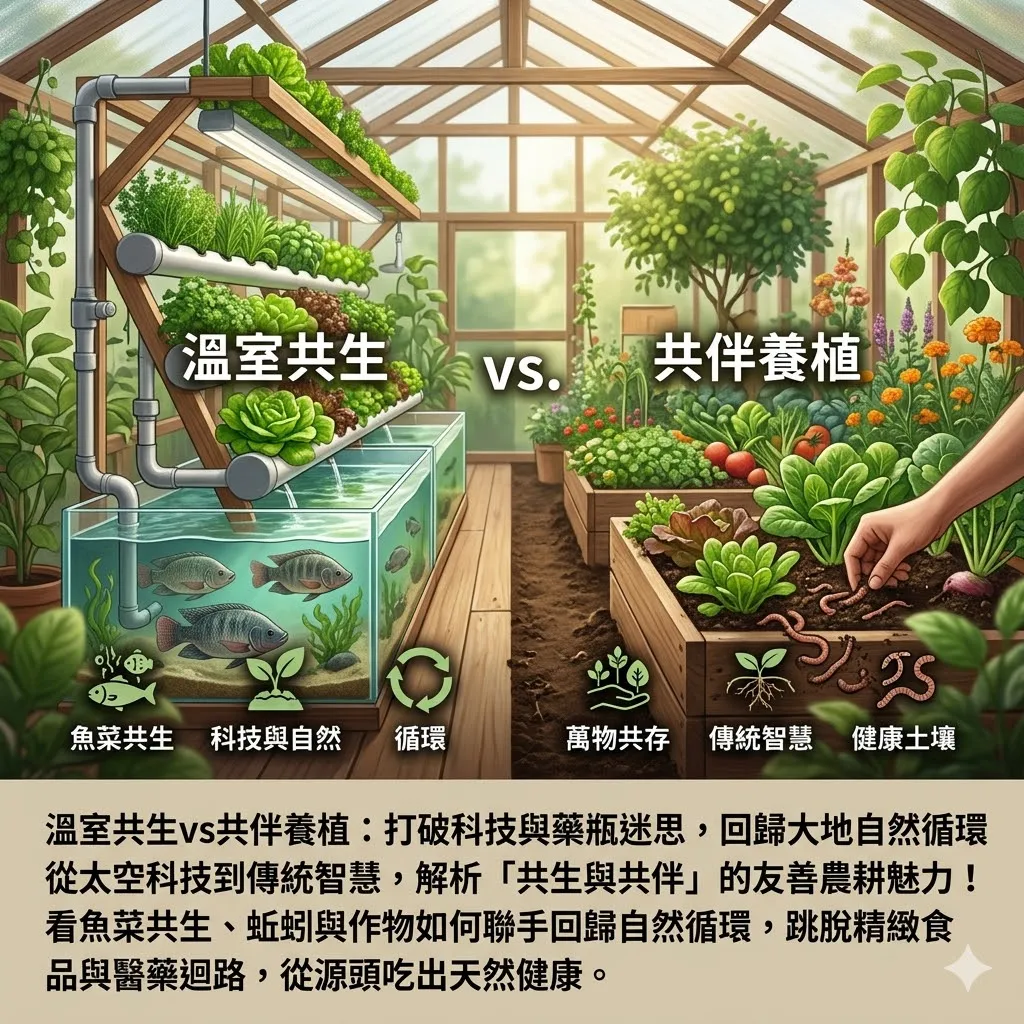
English text of this image
Greenhouse symbiosis vs. companion planting
Icons: aquaponics · technology and nature · cycles · all things coexisting · traditional wisdom · healthy soil.
Caption: breaking the myths of technology and the medicine bottle, and returning to nature’s cycles. From space technology to traditional wisdom, the appeal of eco-friendly farming through symbiosis and companion planting. See how aquaponics, earthworms and crops work together to restore natural cycles, step out of the loop of refined food and medicine, and eat for health from the source.
Enjoyed this article? Get the newsletter
Our newsletter is written in Chinese for now: new articles and series, with an editor’s note. No spam, and you can unsubscribe at any time.