An Invisible Presence: How Do GM Raw Materials Find Their Way onto Your Plate?
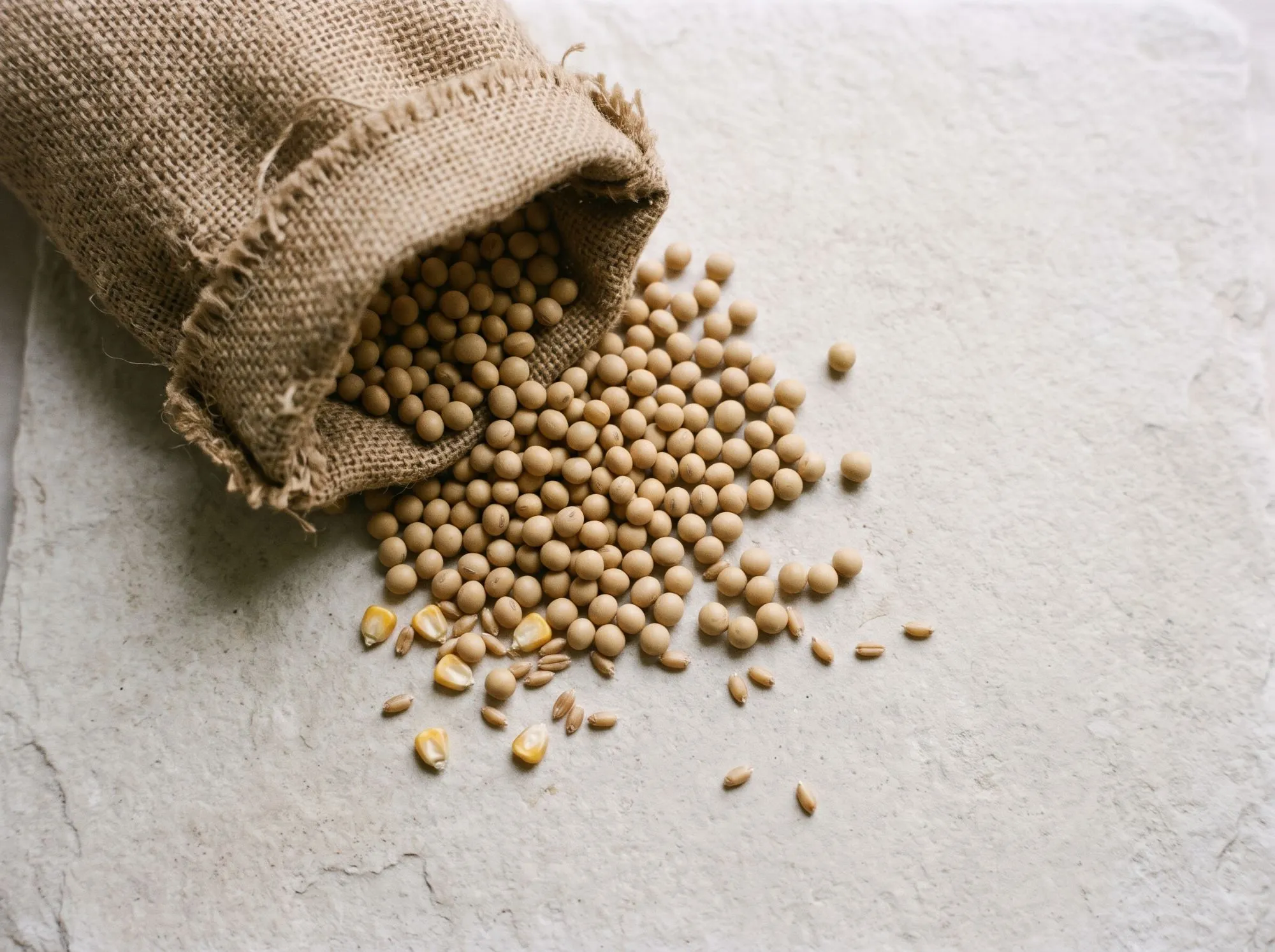
According to statistics, about 75% of soybeans are processed into soybean oil, which is widely used by restaurants for stir-frying, while fructose syrup and cornflour made from corn play an indispensable role in many drink and pastry shops. Food is the first necessity of life, and through “secondary processing”, “genetically modified” foods take on all kinds of forms and find their way into our diet.
Although the Taiwanese government keeps a tight rein on imports of “genetically modified foods”, which may only be imported after the Taiwan FDA has reviewed and registered them, the irony is that countries around the world (Taiwan included) have quietly been researching genetically modified organisms for several decades, amid waves of consumer protest whenever a failed experiment is occasionally exposed by the media.
A Global Survey of Public Opinion: Does Acceptance Differ Between “East and West”?
Taiwan surveyed consumers on “GM foods” and “genetically modified organisms” in 2012 and 2015. The results were as follows:
- In 2015, Pollster ran an online questionnaire asking, “Would you refuse to eat a food because it is ‘genetically modified’?” The results showed:
75% would refuse to eat “GM food”;
22% would “definitely” refuse to eat it;
From this it can be inferred that Taiwanese people do not accept “GM food”.
- In 2012, a consumer survey by the Food Technology Industry Research Center of the Taiwan Institute of Economic Research (台灣經濟研究院) found:
54.5% could not accept “genetic modification technology” being applied to “animals for food”;
36.0% could not accept it being applied to “plants for food”;
58.1% were willing to pay more for food labelled “GMO-free”.
Surveys on “genetic modification” carried out at different times and by different organisations all show that most Taiwanese people have food-safety concerns about eating “GM food”.
Looking at the global picture, by contrast, acceptance of GM food in different countries reflects cultural differences:
- United States: more than 60% accept GM food!
Reports indicate that consumers are generally less opposed to GM food, and the FDA considers that food does not need to be specially labelled as “genetically modified”. Respondents were therefore willing to buy foods that stay fresh longer, and foods such as bread, biscuits and cereals containing GM wheat. - Europe: 61% do not support GM food!
According to a 2010 Eurobarometer survey, consumers generally prefer natural food, an attitude very different from that of American consumers. - Australia: opinion is divided. Compared with a 2007 survey, consumers’ attitudes in 2010 towards “genetically modifying plants to produce food” showed the share who saw it as risky rising to 48%, and support falling to 63%. As a major exporter of farm and livestock products, however, although it worries about the risks, support for crops that can “better withstand drought, resist pests and grow in saline soil” is as high as over 80%.
- Japan: 50% accept GM food.
These are the results of a 2009 survey by the Nikkei (〈日本經濟新聞〉, Nihon Keizai Shimbun) on consumers’ willingness to buy GM food.
Taking the results from all these countries together, consumers’ acceptance of “genetically modified” organisms and crops is generally low. Besides showing that consumers are taking a wait-and-see, reserved attitude towards “GM” food, this also reflects that consumers need more proof of the safety of “GM food” before their negative perceptions can be reversed.
Expert Opinion Is Divided:
In April 2009, Union of Concerned Scientists (UCS) food scientist Sherman set out facts to express a negative view of “GM” crops:
1. The biotech industry has spent billions of US dollars on research and promotion, yet the GM foods and animal feed it has produced have not given American farmers the high returns on their land that were promised.
2. In sub-Saharan Africa, organic and similar farming methods not only reduced dependence on pesticides and synthetic fertilisers but also increased crop yields, with the result that costs fell while incomes rose.
Obermeyer, an entomologist with Purdue University’s agricultural extension programme in the United States, expressed support. He believes that biotech crops have proved successful against the corn’s worst pests, which cannot overcome these insect-resistant GM corn varieties. GM soybeans and corn, in particular, have gained the ability to cope with adverse conditions and resist pests, helping us feed large numbers of livestock and solving many food crises.
Disappearing DNA? Why Can It Sometimes Not Be Detected in the Final Product?
The Taiwan FDA explains that during manufacturing, processes such as fermentation, extraction and purification destroy the original genetic information (DNA fragments) and protein structures. Even with the most advanced instruments, it is hard to tell whether an ingredient came from a GM crop.
In addition, before a GM crop can be used as a food ingredient, it must go through rigorous safety assessment, as well as animal feeding trials and an allergenicity assessment, and be shown to be safe to eat before it is approved. Some people with food allergies reading this may wonder: “Then why can’t many foods be tested in advance? Why do we have to eat them and have an allergic reaction, or even have an allergy test, before we find out which foods our bodies are allergic to?” Although everyone knows that food is not the only thing that causes allergic reactions, most of the items on allergy tests are foods.
A Must-Read for Travellers and Emigrants: GM Labelling Thresholds Differ Widely Between Countries
Taiwan does not yet allow GM crops to be grown, but the world’s five biggest GM-crop countries, the United States, Brazil, Argentina, Canada and India, together grow 91% of the world’s GM crops. So if you care about healthy eating and plan to travel or emigrate abroad, you need to know the local tolerance threshold for labelling foods as “containing GM ingredients”:
| Country | GM ingredient labelling threshold |
| Mainland China | Must be labelled from 0% (strict control) |
| New Zealand, Australia | 1% or more |
| United States, Japan | Mandatory above 5% (since 2023, Japan allows a “non-GM” claim only when no GM content is detected) |
| Canada | 5%; labelling is voluntary |
| Europe | 0.9% or more (strict control) |
| Taiwan, EU | Even if no DNA fragments remain in the final product, it must still be labelled “this product is made from processed GM ingredients” |
Whether a “secondary processed food” counts as “containing GM” ingredients depends on local laws on GM food. Whatever country a product is exported to, it must comply with that country’s rules on GM ingredients.
Where Does Your Food Come From? Learning to Read Labels Is Key
Example 1: a sweetcorn cracker imported from Thailand contains no more than 3% GM corn imported from Myanmar. If it is exported to the United States, Japan, Canada and similar countries, it does not need to be labelled as “containing GM” ingredients; but if it is exported to the EU, New Zealand and Australia, mainland China, Taiwan and so on, it must be labelled as “containing GM” ingredients.
Example 2: if Japan imports sockeye salmon from Alaska, only “cuts” and “packs” it, and then exports it to Taiwan, the country of origin should be labelled as the “United States”. But if the salmon goes through “processing and preparation (seasoning)” or “heating (pan-frying, boiling, stir-frying, deep-frying)”, in trade terms it is considered to have been substantially transformed, and it can be labelled “Japanese sockeye salmon”. So when consumers buy “processed foods”, if they are seasoned, the salmon is not necessarily from Japan.
We Stand at a Wait-and-See Crossroads
GM food (including crops, livestock and aquatic products) is one of the areas many countries are actively researching, and each country’s rules on gene-edited products differ. Some countries take a more lenient view, treating gene editing as equivalent to natural gene mutation and not classifying its products as GM food (GMO). These countries include the United States, the United Kingdom, Australia, Brazil, Argentina and Japan, and in recent years the EU has even shown a trend towards relaxing its definition of GM food.
The Taiwanese government still takes a wait-and-see attitude towards GM technology, but related research is in fact continuing in Taiwan. In future, as the technology matures and market acceptance changes, will GM food be fully “legalised” and enter everyday life? This is not only a scientific question but also a choice in the hands of every consumer.
Note, “GM crops approved around the world”:
rice, corn, soybeans, apples, papayas, pineapples, potatoes, pumpkins, common beans, cowpeas, melons, European plums, American squash, sweet peppers, cotton, rapeseed, sugar beet, aubergines, flax, alfalfa, sugar cane and wheat.
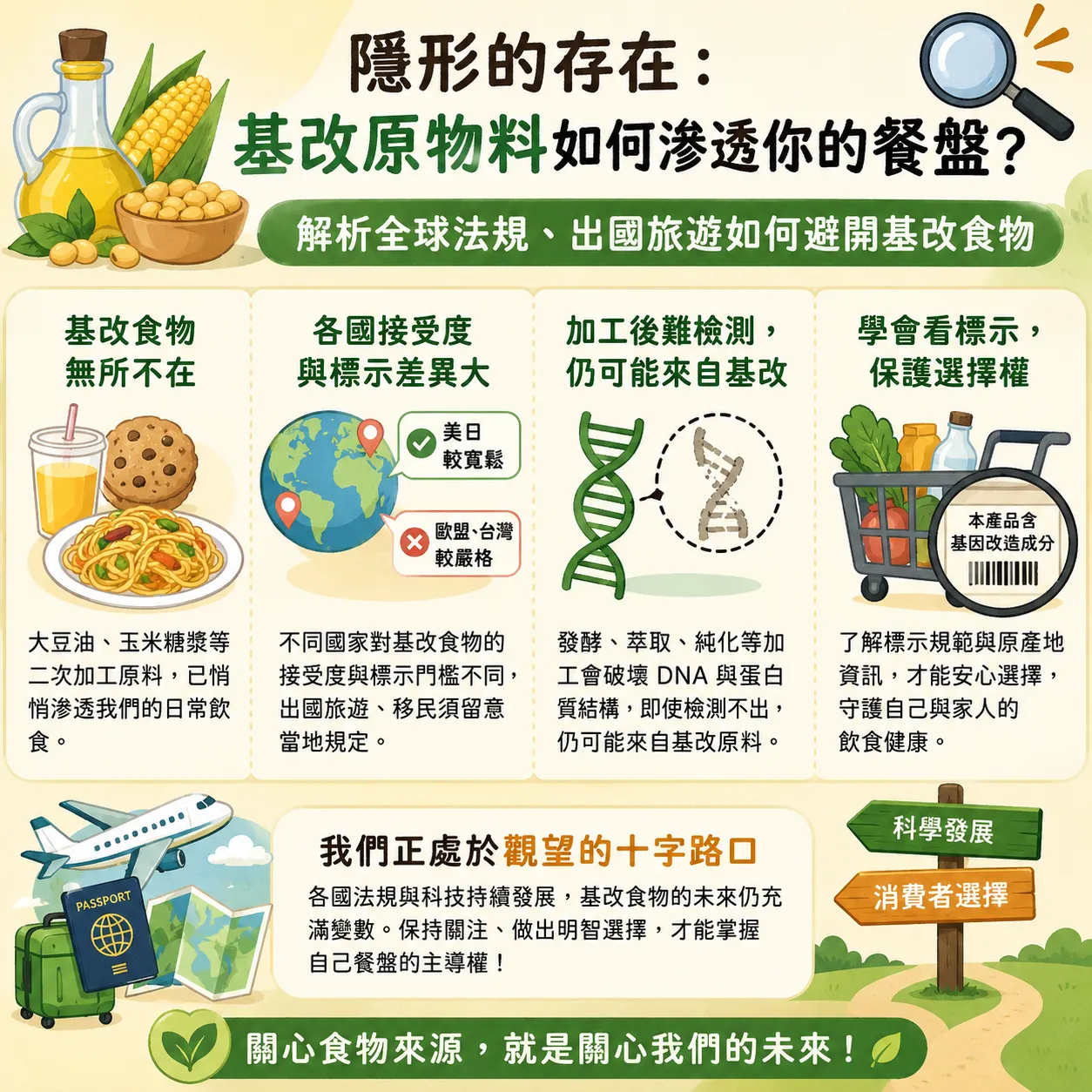
English text of this image
A hidden presence: how GM ingredients get onto your plate. Understanding the rules around the world, and how to avoid GM food when travelling.
- GM food is everywhere: processed ingredients such as soybean oil and corn syrup have quietly worked their way into our everyday diet.
- Acceptance and labelling differ widely: the US and Japan are more relaxed; the EU and Taiwan are stricter. Countries set different thresholds, so check local rules when travelling or moving abroad.
- Hard to detect after processing, but may still be GM: fermentation, extraction and refining break down DNA and protein, so an ingredient may come from GM crops even when tests cannot find it.
- Learn to read labels to keep your choice: “This product contains genetically modified ingredients.” Knowing the labelling rules and the country of origin lets you choose with confidence and protect your family’s diet.
We are at a crossroads, waiting to see: regulations and technology keep developing, and the future of GM food is still uncertain. Stay informed and choose wisely to stay in charge of your own plate. Signposts: scientific development, consumer choice. Footer: caring where food comes from is caring about our future!
Enjoyed this article? Get the newsletter
Our newsletter is written in Chinese for now: new articles and series, with an editor’s note. No spam, and you can unsubscribe at any time.